Everyday
of the year throngs of people surge up the steep
pathways that cut across the Trikuta hillsides
for mile after mile. This show of faith is finely
interwoven with the cultural strands of the
Indian subcontinent, and these pathways have
been trod on for many centuries now. Popular
belief holds that anybody who walks the Himalayan
trail to the goddesses's abode to ask for a
boon rarely goes back disappointed. Whatever
be it, a new enterprise or a forthcoming examination,
marriage or birth, the devout look up to the
Mata For blessings and guidance. There are many
who journey year after year to pay obeisance
regardless of their faith or belief, creed or
class, caste or religion. |
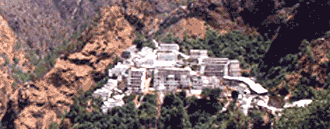 |
|
| Mata
Vaishno Devi established an ashram in the foothills
of the Trikuta Mountain and began to meditate.
As predicted by Lord Rama, her glory started spreading
and people began to flock to her ashram to seek
her blessings. As time passed, a Tantrik called
Gorakh Nath (Demo God), who had a vision of the
episode between Lord Rama and Mata Vaishno Devi,
became curious and wanted to know more about her.
Accordingly, he sent his most able disciple `Bhairon
Nath' to find out. Bhairon Nath started observing
her secretly and realized that despite being a
`Sadhvi', she always carried a bow and arrows
and was always surrounded by langoor (apes) and
a ferocious looking lion. Bhairon, the demon God
took a fancy to her. But the Mata spurned his
advances and fled to the Himalayas to continue
her spiritual quest. |
 |
| The
Yatra to the holy shrine is as fascinating
as the legend associated with it. It goes that
thousands of years ago, a comely maiden called
"Vaishnavi" have been created by the three
lords attained human form and was a devotee of
Lord Vishnu. Having taken a vow of celibacy, she
spent almost all her life in meditation and prayers.
In time she attained enormous spiritual powers
and is believed to have extracted an assurance
from Lord Rama that he will marry her in Kali-Yug
if she persisted in her spiritual quest.
This is why she is also known as Adh Kanwari or
the "eternal virgin". |
 |
|
On the way the
goddess felt thirsty at Banganga and
shot an arrow into the earth from where water
gushed out. Charan Paduka, which
is marked by the imprints of her feet, is the
place where she rested.
The
Goddess then meditated in the cave at Adh
Kanwari. It took Bhairon nine months to
locate her, which is why the cave is known as
Garbh Joon.
When the demon
found her, Mata Vaishno Devi blasted an opening
at the other end of the cave with her trident
and fled to the Holy cave at Darbar (temple).
However, Bhairon
was persistent and followed her there to harass
her. Then goddess became very angry and assuming
the form of Mata Kali, beheaded Bhairon outside
the cave with the aid of the flying disc gifted
to her by Lord Krishna |
 |
On the way the goddess
felt thirsty at Banganga and shot an arrow
into the earth from where water gushed out. Charan
Paduka, which is marked by the imprints of her
feet, is the place where she rested.
The Goddess then meditated in the cave at Adh Kanwari.
It took Bhairon nine months to locate her, which is
why the cave is known as Garbh Joon.
When the
demon found her, Mata Vaishno Devi blasted an opening
at the other end of the cave with her trident and fled
to the Holy cave at Darbar (temple).
However, Bhairon was persistent
and followed her there to harass her. Then goddess became
very angry and assuming the form of Mata Kali, beheaded
Bhairon outside the cave with the aid of the flying disc
gifted to her by Lord Krishna
The
severed head of Bhairon fell at a distant hilltop. In
his dying moments, Bhairon begged and received divine
forgiveness from the goddess. Today, it is believed that
the Yatra is not complete unless the pilgrim has
been to Bhairon ka Mandir (2.6 km from the
main sanctum) as well, after the darshan of Shri
Mata Vaishno Devi.
|
|
Pindiyan inside
the Shrine |
The goddess herself took
up permanent abode in a cave in the Trikuta Mountains
by metamorphosing herself in to three pindis (Rock).
This holy shrine of Mata Vaishno Devi is unique as
it contains the holiest of holy Pindis manifesting the
Mata in her three forms - Maha Kali, Maha Lakshmi
and Maha Saraswati - each form representing a particular
attribute. Maha Kali represents Tamas
Guna, Tamas meaning darkness. In her manifestation
of Kali the omnipotent, absolute and all pervasive, she
is said to be beyond fear and finite existence and is
therefore able to protect her devotees against fear and
to give them limitless peace. Maha Lakshmi represents
Rajas Guna, Rajas meaning prosperity.
In this manifestation, the goddess blesses her devotees
with wealth and prosperity for living a better life. Maha
Saraswati represents Sattav Guna,
Sattav meaning wisdom and knowledge. This manifestation
enables her devotees to distinguish between good and bad
and helps them to adopt the right path in life. The combination
of these three attributes in a single Shakti is
a unique combination, which is what makes it, revered
all over the world. |

